Blog

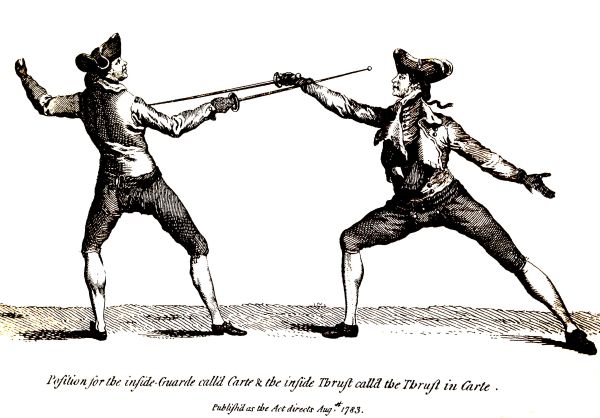
Domenico Angelo’s Lunge

On page 11... "...the arm should be straitened, and the wrist raised above the head, and the point dropt in line to the adversary's breast; being thus situated, you must throw your wrist forward, stepping immediately, or longe about two feet beyond your guard; the left heel, and knee, should be in a perpendicular line,... Continue Reading →

THE LUNGE

[From the French verb alonger, to extend or stretch out] Is the act of extending yourself on the line of direction the full distance of your stride, in order to make your approaches to an adversary’s body in delivering a thrust… All longes are performed from guard position, by first forming the position of extension… then... Continue Reading →

The value of classical fencing in historical fencing interpretation

“Classical fencing is the true, legitimate descendant of medieval swordsmanship, connected to it in an unbroken line – and that this connection bears tremendous importance.”

traditionalfencing's avatarCote du Golfe School of Fencing

This article reflects only my own interpretations and opinions, and not necessarily those of Maestro Ramon Martinez, Maestro Jeannette-Acosta Martinez, or the Martinez Academy of Arms.

To be truly successful, attempts at reconstructing historical European systems of swordsmanship must be informed by classical fencing.

It’s an unfortunate trend today that the overwhelming majority of European swordsmanship enthusiasts, whether they classify themselves under the name HEMA, WMA, historical fencing, or any number of names, either ignore the classical weapons (at best) or scorn them (at worst).  There are of course a myriad reasons for this.  Many individuals are only interested in medieval or renaissance arms, and classical 19th century teaching just doesn’t get their blood moving.  Why bother spending time on it?  Others argue that medieval and renaissance swordsmen didn’t need training in French foil to learn to use an arming sword or a rapier (or whatever), so why should…

View original post 5,267 more words

Choosing the right length for your smallsword blade

traditionalfencing's avatarCote du Golfe School of Fencing

As always, the contents of this post reflect my own opinions and do not necessarily reflect those of Maestro Ramon Martinez, Maestro Jeannette Acosta-Martinez, or the Martinez Academy of Arms.

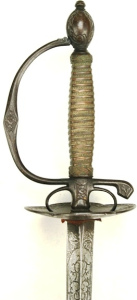
The smallsword is one of the popular historical weapons being taught nowadays, and is arguably my favorite weapon (although really, all the fencing weapons are my favorite).  To learn to fence with a smallsword properly, as with anything, requires proper equipment, starting with an appropriate, quality weapon.  Unfortunately, many folks out there are using blades that are improperly proportioned for them, so it is worthwhile to look at what, historically, was recommended and how to apply these recommendations when choosing a training weapon today.

Guillaume Danet in 1766 and Nicolas Demeuse in 1778 both instruct that the smallsword’s length should be 30 pouces (French “inches”), aka 2.5 pieds (French “feet” = 12 pouces/pied).  Although the pouce was a somewhat variable…
View original post 862 more words

What is a Traditional Martial Art?

A traditional martial art is any form of antagonistic personal combat that is taught as a system, utilizing a scientific pedagogical approach. This includes a specific methodology along with its artistic expression through a regimen of physical training and mental discipline. It is a science because the techniques can be executed and repeated achieving the... Continue Reading →

Website Powered by WordPress.com.

Up ↑